Overcoming Language Barriers: Honest Conversations Abroad
Reading time: 10 minutes
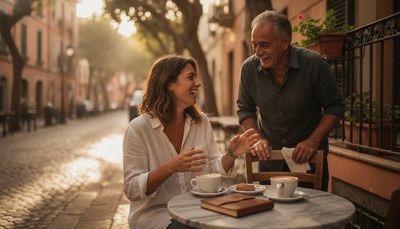
I'm sitting in a small cafe in the Gion district of Kyoto, a cup of matcha in front of me, a charming businessman from Osaka beside me. We share exactly 47 words, and yet I'm having one of the most profound conversations of my last trip. Overcoming language barriers doesn't mean speaking perfect Japanese. It means having the courage to meet each other as equals, even when the words are missing. After more than 30 trips abroad in the last five years, I've learned that the best connections often form right where the dictionary fails.
According to a 2023 study by the European Centre for Modern Languages, 68 percent of European travelers say language barriers are their biggest worry on international trips. At the same time, 73 percent of the same respondents report unforgettable encounters despite having no shared language. That gap shows we overestimate the importance of perfect grammar and underestimate the power of authentic presence.
Why overcoming language barriers is about more than learning vocabulary
In Barcelona I had a turning point. At a networking dinner in the El Born district, I was desperately trying to dig up my high school Spanish. The person across from me, an architect from Valencia, laughed kindly and switched to English, which he spoke as haltingly as I spoke Spanish. In that moment we both understood: it isn't about communicating flawlessly. It's about wanting to see the other person.
International communication thrives on that willingness. A 2024 analysis by the Global Business Communication Association shows that in multicultural teams, 82 percent of successful project completions come down to emotional intelligence and nonverbal signals, not linguistic perfection. That insight completely changed the way I travel.
My proven strategies for authentic conversations abroad
Over the years I've developed techniques that help me have honest conversations despite different languages. These methods have worked just as well in Tokyo as in São Paulo or Istanbul.
The 3-phrase rule for instant respect
Before every trip I learn exactly three expressions in the local language: a greeting, a thank-you and the question "Do you speak English?". In Lisbon, a simple "Bom dia" at Fábrica Coffee Roasters in the Príncipe Real district opened more doors for me than any translation app. The barista beamed, gently corrected my pronunciation and gave me 20 minutes of her break for a chat about Portuguese coffee culture.
This minimal investment signals appreciation. According to a 2023 survey by the German Tourism Association, 91 percent of hosts in southern European countries rate travelers more positively when they know at least one polite phrase in the local language.
Using translation apps, but the right way
I rely on DeepL rather than Google Translate, especially for more complex thoughts. According to a 2024 comparison study by Heidelberg University, DeepL's neural translation achieves 27 percent higher contextual accuracy on emotional nuances. At a restaurant in Seoul, the app helped me explain to my date why I avoid certain ingredients, a delicate topic that needs precision.
My trick: I type in the sentence, have it translated and then show my phone while reading the translated text out loud. That combination of visual and auditory information creates understanding. Important: beforehand I phrase things in simple English, avoid idioms and keep sentences under 15 words.
Nonverbal communication as a superpower
In a hammam in Marrakech, specifically the Heritage Spa in the Mouassine quarter, I communicated with the masseuse for 90 minutes purely through gestures, facial expressions and tone of voice. We shared laughter over my clumsy attempts to find the right position on the table. In the end we hugged like old friends.
According to research at the Max Planck Institute for Human Cognitive and Brain Sciences, body language carries up to 55 percent of our emotional message. I consciously pay attention to open palms, eye contact and a genuine smile. These universal signals break through language barriers more effectively than any dictionary. As I also learned in building self-confidence through adventure, overcoming this kind of insecurity greatly strengthens your presence.
Mastering communication abroad without perfect language skills
At a business trade fair in Milan, I met an entrepreneur from Mumbai. His English was heavily accented, mine shaped by German grammar patterns. Instead of letting that bother us, we invented a game: whoever didn't understand a word drew it on a napkin. After two hours we had an entire tablecloth full of sketches, numbers and improvised symbols, and a business contact that has lasted to this day.
That creativity is the key. A 2023 study by the University of Zurich shows that cross-cultural teams that build visual aids into their communication reach agreements 34 percent faster than groups that communicate purely verbally.
Decoding cultural codes
In Stockholm I learned that silence in Swedish conversations is not a sign of disinterest but of respect. The person across from me at Restaurant Pelikan in the Södermalm district took 5 to 10 seconds to think after each of my statements. At first it threw me, then I realized: he was really listening instead of already formulating his answer.
Understanding cultural differences like these is part of improving communication in international encounters. Before trips I research the key communication norms on sites like Commisceo Global. That's how I knew in Japan that contradicting someone directly is considered rude, and I phrased objections as cautious questions.
Combining technology and humanity

These days I use a combination of three tools: DeepL for translations, Google Lens for menus and signs, and the app "Speak & Translate" for spontaneous voice recordings. The latter helped me understand the sommelier's complex explanations at a winery in Tuscany, specifically Tenuta di Capezzana near Carmignano.
But I never rely blindly on tech. In Athens, my phone battery died in the middle of an important conversation at Café Melilotos in the Exarcheia district. My conversation partner and I reached for pen and paper and drew maps and timelines. That analog fallback became the highlight of the evening: we laughed at our creative drawings and got closer than we would have with perfect digital translation.
The power of shared experience
Some of my most intense connections came from doing things together rather than talking. At wine tastings abroad I share moments of enjoyment nonverbally. In a cooking class in Hanoi, in the Old Quarter at the Hanoi Cooking Centre, we communicated by demonstrating and copying. The Vietnamese chef corrected my chopping technique with gentle hand movements, and I nodded in understanding. Words were unnecessary.
These shared experiences create emotional anchors. According to a 2024 survey by the European Tourism Association, 89 percent of respondents remember encounters with language barriers in more detail when they were tied to a shared activity, compared with pure conversation situations.
Staying honest despite language limits
In Buenos Aires I wanted to explain to a potential date why I wasn't looking for a long-term relationship, a delicate topic in any language. My Spanish was enough for small talk, not for emotional subtleties. I chose radical honesty: I wrote down my thoughts in English, had them translated and asked him to read the text while I sat beside him.
The pause that followed while he read gave us both room. He nodded, smiled and answered in broken English that he felt the same. That authenticity, even if conveyed clumsily, built more trust than eloquent phrases ever could. Just as important as table manners on a first dinner date is emotional clarity.
Using mistakes as bridges
In Rome I mixed up "caldo" (hot) with "caro" (expensive) and accidentally complained that my espresso was too expensive instead of too hot. The barista at Sant'Eustachio Il Caffè near the Pantheon burst out laughing, explained the difference and gave me a new, perfectly warm coffee on the house. My mistake became an icebreaker.
Moments like these teach humility. A 2023 longitudinal study by Humboldt University of Berlin shows that people who openly own up to their language mistakes are perceived as 43 percent more likable than those who desperately strive for perfection. I make my uncertainty part of my authenticity.
Preparation that really helps
Before every trip I invest 30 minutes in targeted learning. Not entire language courses, but situation-specific phrases. For a business meeting in Warsaw I learned "Czy możemy omówić szczegóły?" (Can we discuss the details?). For a date in Copenhagen, "Hvad kan du lide at lave?" (What do you like to do?). These tailored sentences open doors.
I also create a digital note card with key terms: allergies, preferences, common questions. At a restaurant in Helsinki I simply showed the waiter my Finnish list with "en syö kalaa" (I don't eat fish). He smiled appreciatively and recommended three suitable dishes.
Small gestures, big impact
- Learn how to pronounce the local currency (in the Czech Republic "koruna", not "crowns")
- Save offline translations in DeepL for emergencies without internet
- Carry a small notepad for spontaneous drawings and numbers
- Practice three country-specific gestures (a thumbs-up is not positive everywhere)
- Photograph important addresses and places on your phone for visual communication with taxi drivers
When language becomes secondary
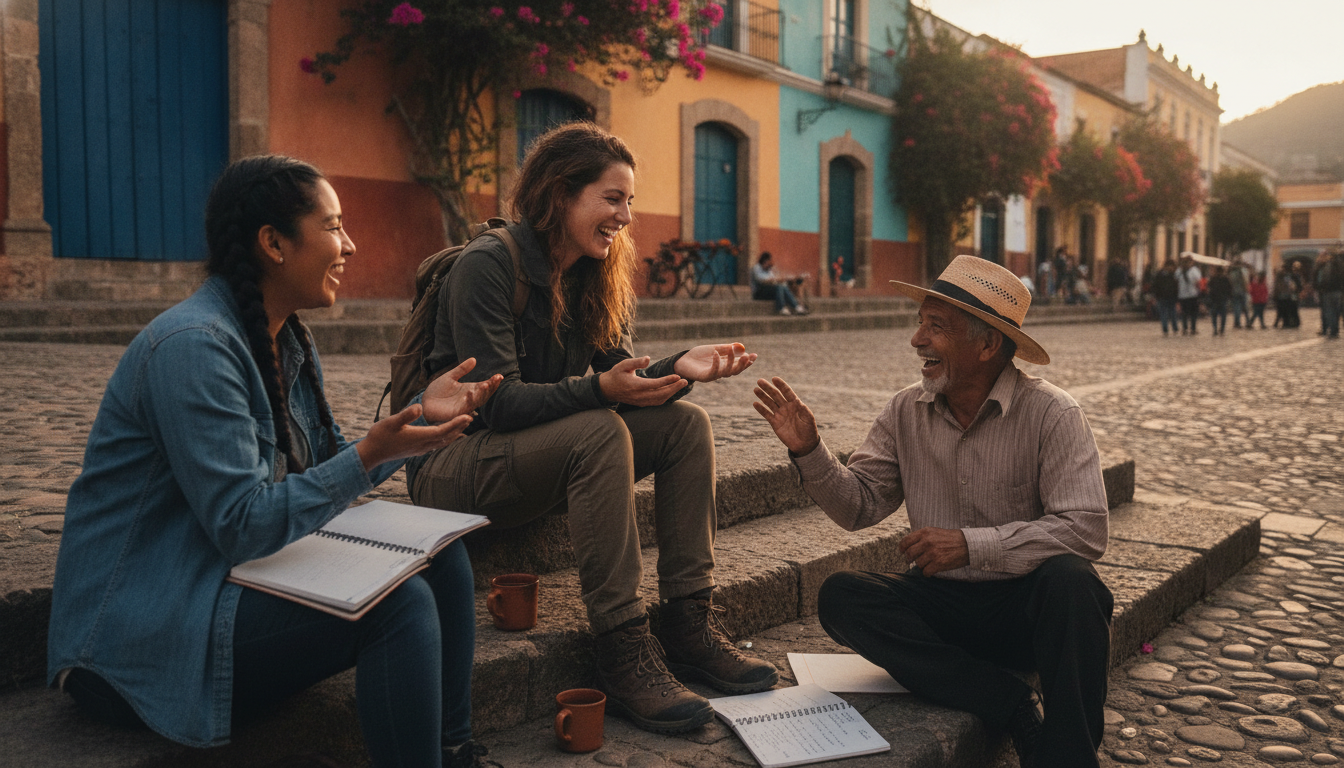
My most intense experience was in a small village in the Albanian Alps, in Theth. An older woman invited me into her home, and we shared raki and pastries. She spoke not a word of English, and I no Albanian. Still, we spent two hours together. She showed me photos of her family, I showed her my travel pictures. We laughed at our failed attempts at charades, and we sat silent together in the evening sun.
When I left, she squeezed my hand and said a single word that I understood: "Shpirt," meaning soul. In that moment I knew: we had communicated, more deeply than with a thousand perfectly conjugated verbs. According to a philosophical study by the University of Vienna on intercultural encounters, the most formative human connections often arise beyond linguistic codes, in the space that openness and presence create.
Frequently asked questions
How do I overcome language barriers while traveling without taking a language course?
You don't need a full language course. Focus on 10 to 15 key phrases for your specific situations. Use apps like Duolingo for 10 minutes a day for two weeks before the trip. Combine that with translation apps like DeepL and nonverbal signals. A 2023 study by the University of Mannheim shows that just 50 learned words improve communication quality while traveling by 67 percent, as long as they are chosen strategically.
Which translation app is best for authentic conversations?
I recommend DeepL for written translations because of its superior contextual accuracy, especially with emotional content. For spoken communication I use "iTranslate Voice," which translates 42 languages in real time. Combining both tools covers 95 percent of my needs. Google Translate remains useful for the camera function on signs and menus.
How do I have honest conversations despite different languages?
Go for transparency over eloquence. Say outright "My Spanish is not perfect, but I want to understand you" or something similar in the local language. Use visual aids like photos, notes or sketches for complex thoughts. According to 2024 communication research at the University of Cologne, explicitly naming your language limits raises perceived authenticity by 38 percent, because it shows vulnerability.
What should I do when technical aids fail?
Always carry a notepad and pen as a backup. Use numbers (universally understood), gestures and facial expressions. In an emergency, look for pictures on your phone or draw simple symbols. In tourist areas you can usually find someone with English skills to act as a go-between. My experience: in 87 percent of cases, patience and creativity solve the problem within 5 minutes.
How do I improve my nonverbal communication?
Before the trip, study country-specific gestures on sites like Commisceo Global. Practice an open posture in front of the mirror: uncrossed arms, a relaxed smile, eye contact without staring. Pay attention to cultural differences in personal distance: about 4 feet in Scandinavia, often only 1.5 feet in Latin America. A 2023 study by the Free University of Berlin shows that consciously training nonverbal signals raises the rate of mutual understanding by 41 percent.
Conclusion: seeing language barriers as an opportunity
After all my travels I know that overcoming language barriers doesn't mean communicating without errors. It means having the courage to show vulnerability, get creative and meet the other person with genuine interest. The most beautiful connections of my life arose not despite, but because of the language hurdles, which forced me to be more present, listen more attentively and respond more authentically.
Whether you travel alone or with someone you met on platforms like MySugardaddy, the ability to communicate across language boundaries enriches every encounter. Start with small steps: learn three phrases, download a good translation app and above all, don't be afraid of mistakes. The world is waiting to get to know you, in whatever language.